The Short Answer
A Health Savings Account (HSA) is a tax-advantaged savings account for medical expenses. You put money in before taxes. It grows tax-free. You take it out tax-free for qualified medical expenses. No other account in the U.S. tax code gets that treatment at all three stages.
That is the 30-second version. The rest of this guide covers who qualifies, how much you can contribute in 2026, the strategies most people miss, and why financial planners quietly consider the HSA the best account most people ignore.
Who Qualifies for an HSA
You need one thing: a High Deductible Health Plan (HDHP).
In 2026, a qualifying HDHP has a minimum annual deductible of $1,700 for individual coverage or $3,400 for family coverage. The maximum out-of-pocket limit is $8,500 for individuals and $17,000 for families.
If your employer offers an HDHP option, you are likely eligible. If you buy insurance on the marketplace, many bronze and some silver plans qualify. Check the plan details for the deductible and out-of-pocket numbers above.
There are a few disqualifiers:
- ●You cannot be enrolled in Medicare
- ●You cannot be claimed as a dependent on someone else's tax return
- ●You cannot have other non-HDHP coverage (with limited exceptions like dental, vision, and Direct Primary Care as of 2026)
If you meet the HDHP requirement and none of the disqualifiers apply, you are in.
2026 Contribution Limits
The IRS sets new limits every year. Here are the 2026 numbers:
| Coverage Type | Annual Limit |
|---|---|
| Individual | $4,400 |
| Family | $8,750 |
| Catch-up (age 55+) | +$1,000 |
A few things to know. Your employer's contributions count toward these limits. If your employer puts in $1,000, you can contribute up to $3,400 individually or $7,750 for family coverage.
The catch-up contribution is per person. If both you and your spouse are 55+, you each get an extra $1,000 through your own HSAs.
You have until April 15, 2027 to make contributions that count for the 2026 tax year.
The Triple Tax Advantage
This is why the HSA is special. Three tax benefits, one account.
1. Tax-free contributions. Every dollar you put in reduces your taxable income. If you max out the individual limit at $4,400 and you are in the 24% bracket, that is $1,056 back on your federal taxes. Add state taxes and FICA savings through payroll deduction and the number goes higher.
2. Tax-free growth. Your HSA can be invested in index funds, mutual funds, and other assets. The gains are never taxed. A 401(k) defers the tax. A regular brokerage account taxes your gains every year. An HSA? Zero tax on growth. Ever.
3. Tax-free withdrawals. When you take money out for qualified medical expenses, you pay nothing. No income tax. No capital gains tax. No penalties.
No other account does all three. A 401(k) taxes your withdrawals. A Roth IRA taxes your contributions. The HSA is tax-free at every stage. Financial planners call this the "triple tax advantage" and it is the single best tax deal available to most Americans.
For a detailed comparison with other retirement accounts, see our HSA vs 401(k) vs Roth IRA breakdown.
HSA vs FSA: Quick Comparison
These two accounts sound similar. They are not.
| Feature | HSA | FSA |
|---|---|---|
| 2026 Limit | $4,400 / $8,750 | $3,400 |
| Rollover | Unlimited, forever | Use-it-or-lose-it |
| Portability | Yours permanently | Tied to employer |
| Investable | Yes | No |
| Eligibility | Requires HDHP | Any employer plan |
The FSA is a fine tool for predictable medical expenses in a single year. The HSA is a long-term wealth-building account that happens to cover medical expenses too.
The biggest difference is rollover. FSA money you do not spend by year-end disappears. HSA money rolls over forever and keeps growing.
We wrote a full HSA vs FSA comparison if you want the complete breakdown.
The Delayed Reimbursement Strategy
This is where most HSA guides stop. This is where it gets good.
The IRS has no deadline on HSA reimbursements. You can pay a medical bill out of pocket today, save the receipt, and reimburse yourself from your HSA years later. Or decades later.
Why would you do this? Because every dollar that stays in your HSA keeps growing tax-free.
Here is a simple example. You have a $1,000 dental bill. If you pay it with your HSA card, that $1,000 is gone. If you pay out of pocket and leave that $1,000 invested at 7%, it becomes $1,967 in 10 years and $3,870 in 20 years. All tax-free when you eventually reimburse yourself.
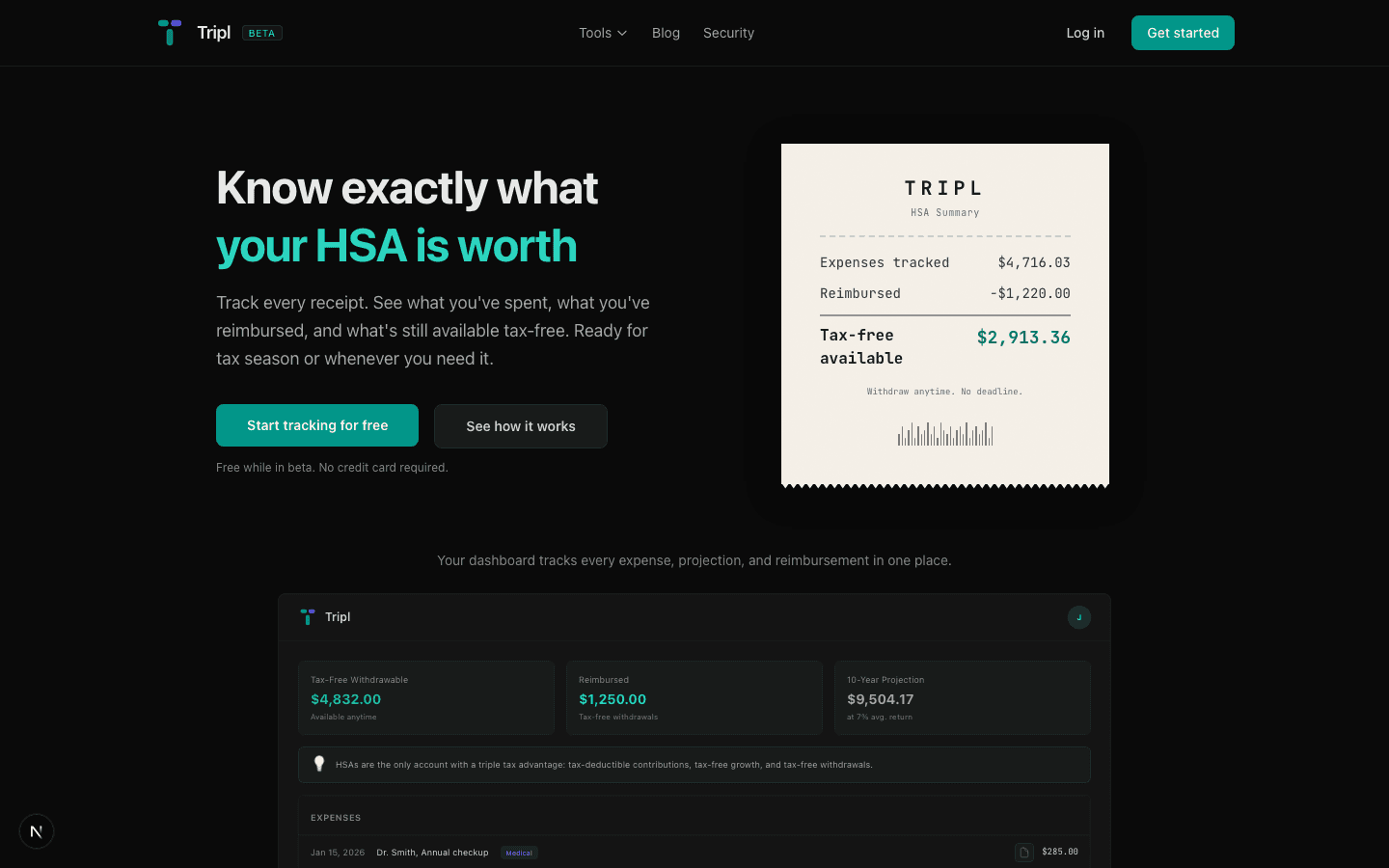
The catch: you need receipts. No receipt, no reimbursement. That is why tracking your medical expenses matters. A tool like Tripl makes this easy by storing your receipts and tracking your reimbursable balance over time.
For the full strategy, read our HSA reimbursement guide.
Your HSA as a Retirement Account
After age 65, your HSA becomes even more flexible.
You can still withdraw tax-free for medical expenses at any age. That does not change. But after 65, you can also withdraw for any purpose. Non-medical withdrawals after 65 are taxed as ordinary income. No penalty.
That makes your HSA work exactly like a traditional 401(k) for non-medical spending after 65. Except the HSA has two advantages the 401(k) does not:
- ●Medical withdrawals are still completely tax-free
- ●There are no required minimum distributions (RMDs)
Fidelity's 2026 estimate says a 65-year-old retiring this year will spend about $185,500 on health care in retirement, per person and before long-term care. That is a lot of tax-free withdrawals waiting to happen.
The play: treat your HSA as a long-term investment account now. Max contributions. Invest the balance. Pay current medical expenses out of pocket. By the time you retire, you could have a six-figure balance that covers healthcare costs completely tax-free.
We go deeper on this in Your HSA Is a Retirement Account.
Common HSA Mistakes
Here are the errors that cost people the most money. We cover all seven in detail in our HSA mistakes guide, but here is the short version.
Keeping your balance in cash. About 80% of HSA holders never invest their balance. At 0.1% interest vs. 7% invested returns over 20 years, the difference on $4,400/year contributions is over $104,000. Most long-term holders move the balance into index funds.
Using your HSA for every expense. Every swipe of the HSA debit card stops that money from growing. If your cash flow allows it, pay out of pocket and let your HSA grow.
Not saving receipts. The reimbursement strategy only works with documentation. No receipt means no future tax-free withdrawal.
Missing the HDHP math. An HDHP with an HSA often costs less than a traditional plan once you factor in lower premiums, tax savings, and investment growth. Run the total numbers, not just the deductible.
Forgetting catch-up contributions. After 55, you get an extra $1,000/year. Do not leave it on the table.
How to Get Started
Step 1: Check your health plan. Confirm you have a qualifying HDHP. Look for the deductible and out-of-pocket numbers. If you are not sure, ask your HR department or insurance provider.
Step 2: Open an HSA. Your employer may offer one through a specific provider. If not, you can open one independently through Fidelity, Lively, or other HSA providers. Look for low fees and good investment options.
Step 3: Set up contributions. Payroll deduction is ideal because you also save on FICA taxes (7.65%). Set it to max out the annual limit. For individual coverage in 2026, that is about $367/month.
Step 4: Invest the balance. Once you have a cash buffer for near-term medical expenses, move the rest into low-cost index funds. This is where the real growth happens.
Step 5: Start tracking receipts. Every medical expense is a future tax-free withdrawal. Build the habit now.
Step 6: Learn what qualifies. The list of HSA-eligible expenses is longer than you think. Sunscreen, contact lens solution, over-the-counter medications, acupuncture. Know the rules and use them.
FAQ
How is an HSA different from health insurance?
An HSA is not insurance. It is a savings and investment account that works alongside your health insurance. Your HDHP covers major medical costs after you meet the deductible. Your HSA helps you pay for expenses (including that deductible) with pre-tax dollars. You need the HDHP to qualify for the HSA, but they serve different purposes.
Can I use my HSA for my spouse or dependents?
Yes. You can use HSA funds for qualified medical expenses for your spouse and tax dependents, even if they are not on your HDHP. The expenses just need to qualify under IRS Section 213(d).
What happens to my HSA if I change jobs?
Nothing. Your HSA is yours. It is not tied to your employer. When you leave a job, your HSA balance stays with you. You can keep contributing if you still have an HDHP through your new employer or marketplace plan.
What happens if I lose my HDHP coverage?
You keep your HSA and can still withdraw funds tax-free for medical expenses. You just cannot make new contributions until you have a qualifying HDHP again. Your existing balance stays invested and keeps growing.
Can I withdraw HSA money for non-medical expenses?
Before age 65, non-medical withdrawals are taxed as income plus a 20% penalty. After 65, the penalty goes away and non-medical withdrawals are taxed as ordinary income (just like a 401(k)). Medical withdrawals are always tax-free at any age.
Is there a deadline to use my HSA funds?
No. There is no expiration date. Your HSA balance rolls over every year indefinitely. There is also no deadline on reimbursements. You can reimburse yourself for a medical expense from 10 years ago as long as the expense happened after you opened your HSA and you have documentation.
*This is educational content, not financial or tax advice. Consult a qualified professional before making decisions about your HSA.*