Most HSA Holders Are Playing Defense
The Health Savings Account is the only account in the U.S. tax code that gives you tax-free contributions, tax-free growth, and tax-free withdrawals. No 401(k) or Roth IRA can match all three. Yet most people treat their HSA like a checking account for doctor visits.
That is a losing strategy. And it is only one of several mistakes that silently drain the value of your HSA over time.
Tripl is not a financial advisor. This post is education, not a recommendation for your situation.
Here are seven of the most common HSA mistakes, ranked by how much they cost you. Fix even two or three of these and you will be in a fundamentally different financial position ten years from now.
Mistake #1: Keeping Your HSA in Cash
This is the most expensive mistake on the list, and roughly 80% of HSA holders make it.
Most HSA providers default your balance to a low-interest savings or money market account. It earns somewhere between 0.01% and 0.5% APY. Meanwhile, inflation runs at 2% to 4%. Your money is actually losing purchasing power every single day it sits in cash.
Here is the cost of this mistake in real numbers.
Say you contribute $4,400 per year for 20 years. In cash at 0.1% APY, your balance would be around $88,900. Invested in a broad market index fund averaging 7% annual returns, your balance would be approximately $193,000. 7% is a long-run historical average, not a guarantee. Some years are negative.
That is over $104,000 you never earned because you left the default setting alone. All tax-free growth you will never get back.
The fix: Log into your HSA provider's investment platform. The move most long-term holders make is shifting everything above a small cash buffer into low-cost index funds. Keep enough cash for near-term medical bills you could not cover out of pocket. Set new contributions to auto-invest. Whether that fits you depends on your risk tolerance and cash needs. It takes 15 minutes and can be worth six figures over a career.
Mistake #2: Using Your HSA for Every Medical Expense
This sounds counterintuitive. Why would paying for medical expenses with your medical savings account be a mistake?
Because every dollar you spend from your HSA is a dollar that stops growing tax-free.
The reimbursement strategy is the play: pay medical expenses out of pocket with your regular credit card or bank account. Save the receipt. Let your HSA balance stay invested and grow. Reimburse yourself months, years, or decades later, completely tax-free and with no deadline.
A $200 doctor visit paid from your HSA today is gone. That same $200 left invested at 7% for 20 years becomes $773 in tax-free money. Plus, you accumulate a growing pile of receipts that function as a flexible, tax-free cash reserve you can tap at any time.
The fix: If your cash flow allows it, stop swiping your HSA debit card. Pay medical bills with your regular card. Save every receipt. Your future self will thank you.
Mistake #3: Not Keeping Receipts
You decided to use the reimbursement strategy. Great. But you threw away the receipt. Or you never downloaded the explanation of benefits from your insurance portal. Or you have no system for tracking what you have spent.
Without documentation, you cannot prove that your future HSA withdrawals are for qualified medical expenses. The IRS could treat those withdrawals as taxable income plus a 20% penalty (if you are under 65).
This is not a theoretical risk. If you are audited, you need records. And the reimbursement strategy only works if you can match withdrawals to documented expenses.
The fix: Build a simple system. After every medical expense, take a photo of the receipt or download the EOB. Store it in a dedicated folder (cloud storage, a notes app, or a tracking tool like Tripl). Record the date, provider, and amount. See the HSA tracker options if you want an app. Do this consistently and your reimbursement pile becomes a reliable, documented asset.
Mistake #4: Not Maximizing Your Employer Match
Some employers contribute to your HSA as part of your benefits package. Common structures include a flat annual contribution ($500 to $1,500) or a matching contribution (dollar-for-dollar up to a certain amount).
This is free money, just like a 401(k) match. But unlike a 401(k) match, many employees do not even realize it exists or they fail to contribute enough to trigger the full match.
The fix: Check your benefits summary. Find out if your employer contributes to your HSA and whether there is a match. If there is, make sure you are contributing at least enough to capture the full amount. Then aim to max out the rest of the contribution limit ($4,400 individual or $8,750 family for 2026, minus what your employer contributes).
Mistake #5: Forgetting Catch-Up Contributions After 55
Once you turn 55, the IRS allows an additional $1,000 per year in HSA contributions. This catch-up amount is on top of the standard limit and has been $1,000 for several years.
Many people either do not know about catch-up contributions or they forget to update their payroll deduction after their 55th birthday. That is $1,000 in tax-free investment space lost each year.
For married couples where both spouses are 55+, the opportunity is even larger. Each spouse can contribute the extra $1,000 through their own HSA, for a total of $2,000 in additional annual contributions.
The fix: If you are 55 or older (or turning 55 this year), contact your HR department or benefits administrator. Increase your HSA contribution by $1,000. If your spouse also qualifies, make sure they have their own HSA for their catch-up contribution.
Mistake #6: Using Your HSA for Non-Qualified Expenses
This one can be genuinely painful. If you withdraw HSA funds for a non-qualified expense before age 65, you owe income tax on the withdrawal plus a 20% penalty.
At the 24% federal bracket, a $1,000 non-qualified withdrawal costs you $440 in taxes and penalties. That is nearly half the money gone.
Common ways this happens:
- ●Swiping your HSA debit card at a store that sells a mix of eligible and non-eligible products, and accidentally including non-qualified items
- ●Assuming something is HSA-eligible when it is not (gym memberships, cosmetic procedures, general wellness supplements)
- ●Not understanding the difference between "medical expense" and "health expense" in the eyes of the IRS
After age 65, the penalty disappears but you still owe income tax on non-qualified withdrawals (making your HSA function like a traditional 401(k) for those purchases). That is not terrible, but it is worse than paying for qualified expenses tax-free.
The fix: Know what qualifies. The IRS defines eligible expenses under Section 213(d). When in doubt, check before you swipe. And if you are under 65, be especially careful. The 20% penalty is steep.
Mistake #7: Treating Your HSA Like a Short-Term Account
The biggest strategic error is thinking about your HSA as a tool for this year's medical bills. That framing leads to every other mistake on this list: keeping it in cash, spending it immediately, not tracking receipts.
Your HSA is a 30, 40, or 50-year account. It has no required minimum distributions. It grows tax-free. After 65, it functions as both a medical fund and a retirement account. Dollar for dollar, no other account in the tax code offers this combination of flexibility and tax-free treatment.
The right frame: your HSA is a retirement and wealth-building account that happens to have a medical receipt requirement. Every receipt you save is a future tax-free withdrawal. Every year you let it grow is a year closer to financial flexibility.
The fix: Shift your mindset. Max your contributions. Invest the balance. Pay medical bills out of pocket. Track your receipts. Play the long game.
How Much These Mistakes Cost
Let us put a number on it. Assume you make these corrections today at age 35, you contribute the individual max ($4,400/year), and your investments earn 7% annually.
- ●Investing instead of cash: ~$104,000 more by age 55
- ●Reimbursement strategy vs. spending immediately: ~$40,000 to $80,000 in additional growth (depending on medical expenses)
- ●Capturing catch-up contributions from 55 to 65: ~$15,000 additional
- ●Avoiding one $1,000 non-qualified withdrawal: ~$440 saved in taxes and penalties
The total difference between an optimized HSA and a neglected one can easily exceed $150,000 over a career. That is not a rounding error. That is a house down payment, a year of retirement income, or a college fund.
Start Fixing Today
You do not need to fix everything at once. For most people the biggest lever is getting the balance invested. Then set up a receipt-tracking system. Then check your contribution amount.
Each fix takes 10 to 15 minutes. Together, they can change the trajectory of your financial future by six figures.
Avoid These Mistakes Automatically
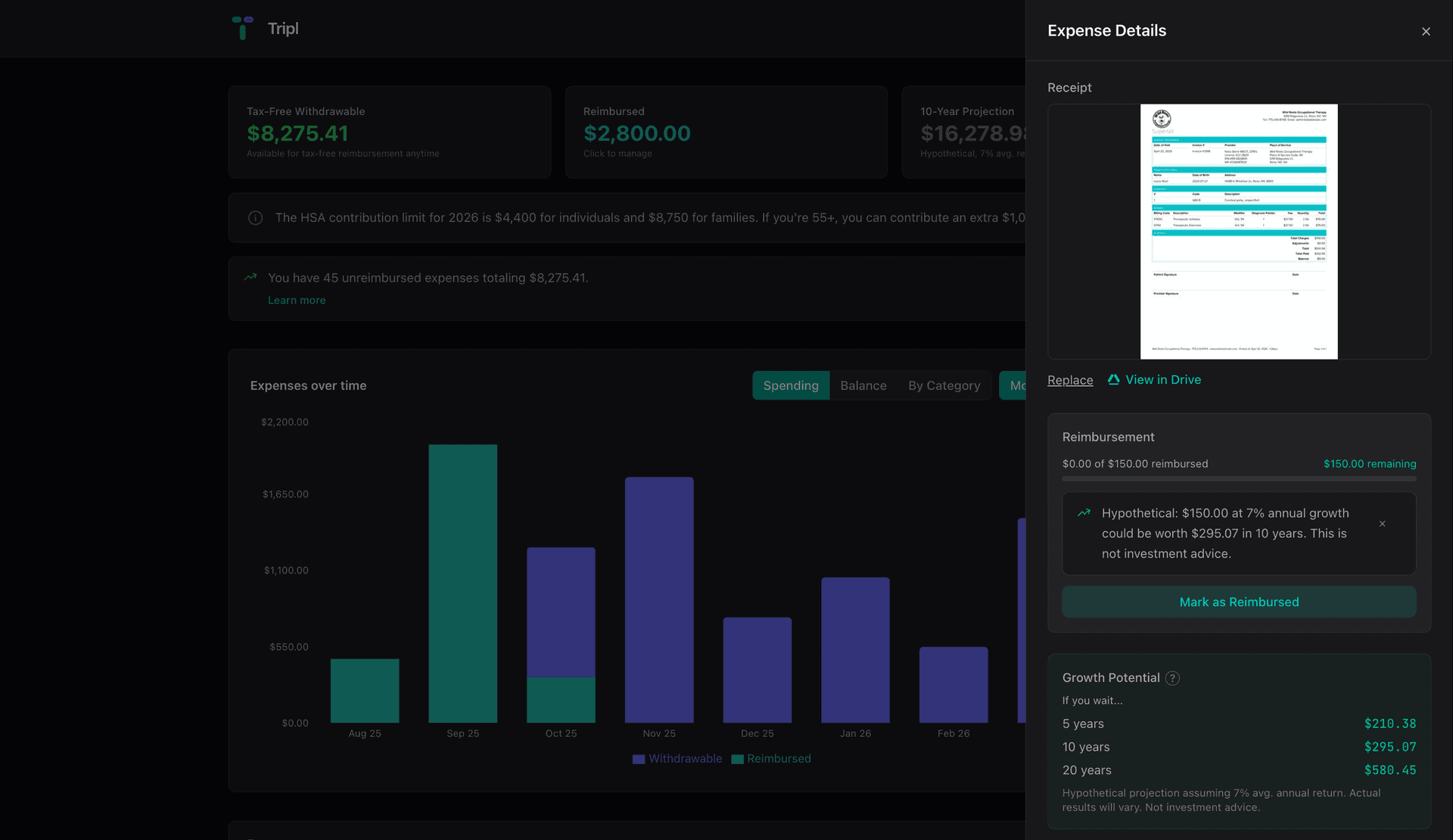
Most of these mistakes come from not tracking receipts or not knowing your totals. Tripl logs every expense, keeps your reimbursement records in one place, and generates a tax-year PDF when you need it. It also projects growth on unreimbursed expenses so you can decide when to claim them.
*This is educational content, not financial or tax advice. Consult a qualified professional before making decisions about your HSA.*