Your HSA Covers More Than You Think
Therapy costs $150 to $250 per session. A psychiatrist visit runs $200 to $500. ADHD medication can hit $300/month without insurance. These numbers stop people from getting help.
But if you have an HSA, you might already have tax-free money sitting there that covers all of it.
Every dollar you spend on mental health through your HSA is pre-tax. At a 25% combined tax rate, a $200 therapy session really costs you $150 in after-tax dollars. Over a year of weekly sessions, that tax savings is $2,600.
What Your HSA Covers for Mental Health
Here is the full list. All of these are qualified medical expenses under IRS Section 213(d).
Therapy and Counseling
- ●Psychologist sessions (PhD or PsyD)
- ●Licensed Professional Counselor (LPC) sessions
- ●Licensed Clinical Social Worker (LCSW) sessions
- ●Licensed Marriage and Family Therapist (LMFT) sessions
- ●Cognitive Behavioral Therapy (CBT)
- ●Dialectical Behavior Therapy (DBT)
- ●EMDR therapy for trauma
- ●Group therapy sessions
The provider must be licensed. If they have a state license and are treating a mental health condition, your HSA covers it.
Psychiatry
- ●Initial psychiatric evaluation ($300 to $500)
- ●Medication management visits ($100 to $300)
- ●Combined therapy and medication sessions
Psychiatrists are MDs who specialize in mental health. They can prescribe medication, which makes them different from psychologists and counselors. Your HSA covers both the visits and the prescriptions.
Prescribed Medications
- ●Antidepressants (SSRIs like Prozac, Zoloft, Lexapro)
- ●Anti-anxiety medications (Buspar, hydroxyzine)
- ●ADHD medications (Adderall, Ritalin, Vyvanse, Concerta)
- ●Mood stabilizers (Lamictal, lithium)
- ●Antipsychotics when prescribed for a mental health condition
- ●Sleep medications prescribed for insomnia related to anxiety or depression
If a licensed provider prescribed it for a mental health condition, your HSA covers it. Period.
Substance Abuse Treatment
- ●Inpatient rehabilitation programs
- ●Outpatient treatment programs
- ●Detox programs
- ●Counseling for addiction (alcohol, drugs, behavioral addictions)
- ●Medication-assisted treatment (Suboxone, naltrexone, methadone)
Substance abuse treatment is a qualified medical expense. The IRS does not distinguish between physical and mental health conditions for HSA eligibility.
Telehealth and Online Therapy
- ●BetterHelp, Talkspace, and similar platforms (when provided by licensed therapists)
- ●Virtual psychiatry appointments
- ●Telehealth therapy sessions through your insurance network
Telehealth therapy has the same HSA eligibility as in-person therapy. The provider needs to be licensed. The platform itself is not what qualifies. The licensed professional providing the service is what matters. The 2026 telehealth rules spell out what platforms now accept.
What Your HSA Does NOT Cover
A few things that seem related but are not HSA-eligible:
- ●Meditation apps (Calm, Headspace). Not a medical expense.
- ●Life coaching. Not performed by a licensed health provider.
- ●Self-help books and courses. Not a medical expense.
- ●Gym memberships for mental health. Not eligible unless you have a Letter of Medical Necessity from your doctor for a specific diagnosed condition.
- ●Emotional support animal costs. The IRS does not currently recognize ESAs as a qualified medical expense. Service animals for diagnosed conditions are different and may qualify.
The Cost Breakdown: Therapy With and Without Your HSA
Let us say you see a therapist weekly at $200/session. Your insurance covers 60% after your deductible. Your out-of-pocket cost per session after insurance is $80.
Without HSA: $80/session in after-tax dollars. At a 25% tax rate, you earned $107 to pay that $80.
With HSA: $80/session in pre-tax dollars. You earned $80 to pay that $80. You saved $27 per session.
Over 50 sessions in a year: $1,350 in tax savings. That is 6 free sessions worth of savings.
| Scenario | Cost Per Session | Annual Cost (50 sessions) | Tax Saved |
|---|---|---|---|
| After-tax dollars | $107 earned to pay $80 | $5,350 earned | $0 |
| HSA (pre-tax) | $80 earned to pay $80 | $4,000 earned | $1,350 |
If cost has been a barrier to getting help, this changes the math.
The Reimbursement Angle
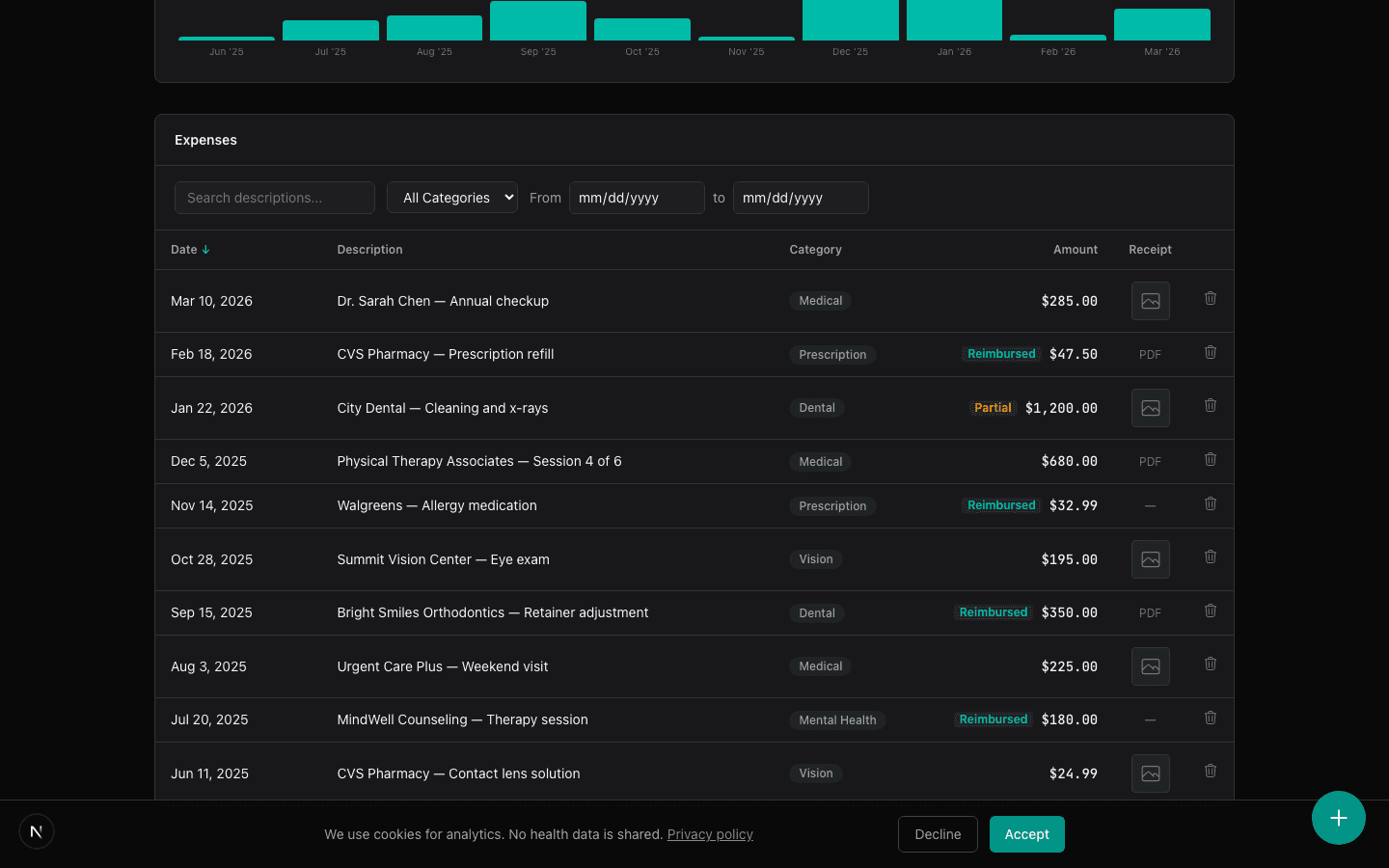
Therapy is one of the easiest recurring expenses to track with the delayed reimbursement strategy. Here is why.
Weekly therapy generates a receipt every single week. Same provider, same amount, predictable schedule. It is the ideal expense to pay out of pocket and save for later reimbursement.
If you pay $80/week out of pocket for therapy and save every receipt, that is $4,160/year in reimbursable expenses. Over 5 years, that is $20,800 in receipts you can reimburse from your HSA at any time, tax-free.
Meanwhile, that $4,160/year stays invested in your HSA. At 7% returns over those 5 years, it grows to roughly $25,000. You can reimburse the $20,800 and still have $4,200 left growing.
The receipts are straightforward. Your therapist's office provides a receipt or superbill after every session. Your insurance company sends an Explanation of Benefits (EOB). Either one works as documentation.
Getting Started
If you have not used your HSA for mental health expenses before, here is what to do:
- ●Check your HSA balance. Log into your provider's website. See what is available.
- ●Verify your provider is licensed. Check their credentials on your state's licensing board.
- ●Ask for a receipt or superbill. Your provider's office can generate one after each visit.
- ●Decide: swipe or save. Use your HSA debit card now, or pay out of pocket and save the receipt for later.
- ●Check the [full eligible expenses list](/blog/hsa-eligible-expenses-list). Mental health is just one category. You might be missing other qualified expenses too.
Your HSA exists for exactly this. Taking care of your health. Mental health included.
Frequently Asked Questions
Does my therapist need to accept my HSA specifically?
No. Your HSA is not insurance. It is a payment method. You can use your HSA debit card or reimburse yourself for any qualified medical expense. It does not matter whether the provider "accepts" HSAs. If they are licensed and treating a medical condition, the expense qualifies.
Can I use my HSA for my child's therapy?
Yes. Your HSA covers qualified medical expenses for your spouse and tax dependents. Therapy, psychiatry, and prescribed medications for your children are all eligible.
Is couples therapy HSA-eligible?
It depends. If a licensed therapist is treating a diagnosed mental health condition for one or both partners, it qualifies. General relationship counseling without a medical diagnosis may not. Ask your therapist to document the medical necessity.
What if I pay for therapy before meeting my deductible?
Your HSA can cover expenses before you meet your insurance deductible. In fact, this is one of the most common uses. You are paying the full cost out of your HSA (pre-tax) until your insurance kicks in.
*This is educational content, not financial or tax advice. Consult a qualified professional before making decisions about your HSA.*