$22.78 in, $15.69 out. That is the gap on a real CVS receipt. $22.78 was spent. $15.69 actually qualified for HSA reimbursement. Two items in the bag. Only one passed the test.
Yes, you can use your HSA at CVS. Swipe your HSA debit card for eligible items at any CVS register or on cvs.com. You can also pay any way you like and reimburse yourself later. Either way, the receipt is what you keep.
You leave CVS with a receipt. Some items are HSA-eligible, some are not. Here is how to tell, line by line.
CVS is one of the easier retailers to decode. The receipt does most of the work for you. A small "F" prefix flags every eligible item. A summary line at the bottom adds up the FSA-eligible total separately from the regular total. Once you know where to look, every CVS trip becomes a clean HSA record.
This post is part of a five-post series on receipt eligibility. The hub is here: How to Tell If Something on Your Receipt Is HSA-Eligible.
How CVS Marks FSA-Eligible Items
CVS prints an "F" next to items its point-of-sale system flags as FSA candidates. Think of it as a hint, not the final word. No F means the item is plain retail in CVS's database.
The F flag is CVS-specific shorthand. It is not a federal code or an IRS marker. It is CVS telling you their point-of-sale system tagged the item. Likely FSA or HSA match.
Look down the left edge of the item list. Items with an F prefix are flagged. Items without an F are general retail.
The same flag applies to FSA and HSA accounts. CVS uses "FSA" as the label, but the eligibility rules overlap with HSA for almost every item. If it qualifies for FSA, it qualifies for HSA.
The flag is printed at the register based on CVS's internal product database. Each SKU has a classification. The flag is helpful, but it is not always the final eligible amount. That number lives on a separate summary line.
The FSA Summary at the Bottom (Authoritative)
CVS prints a summary line near the bottom of the receipt. It reads "F=FLEXIBLE SPENDING ACCT SUMMARY (FSA) Health Care Eligible Total" followed by a dollar amount. That dollar amount is the authoritative number. Use it for your HSA records.
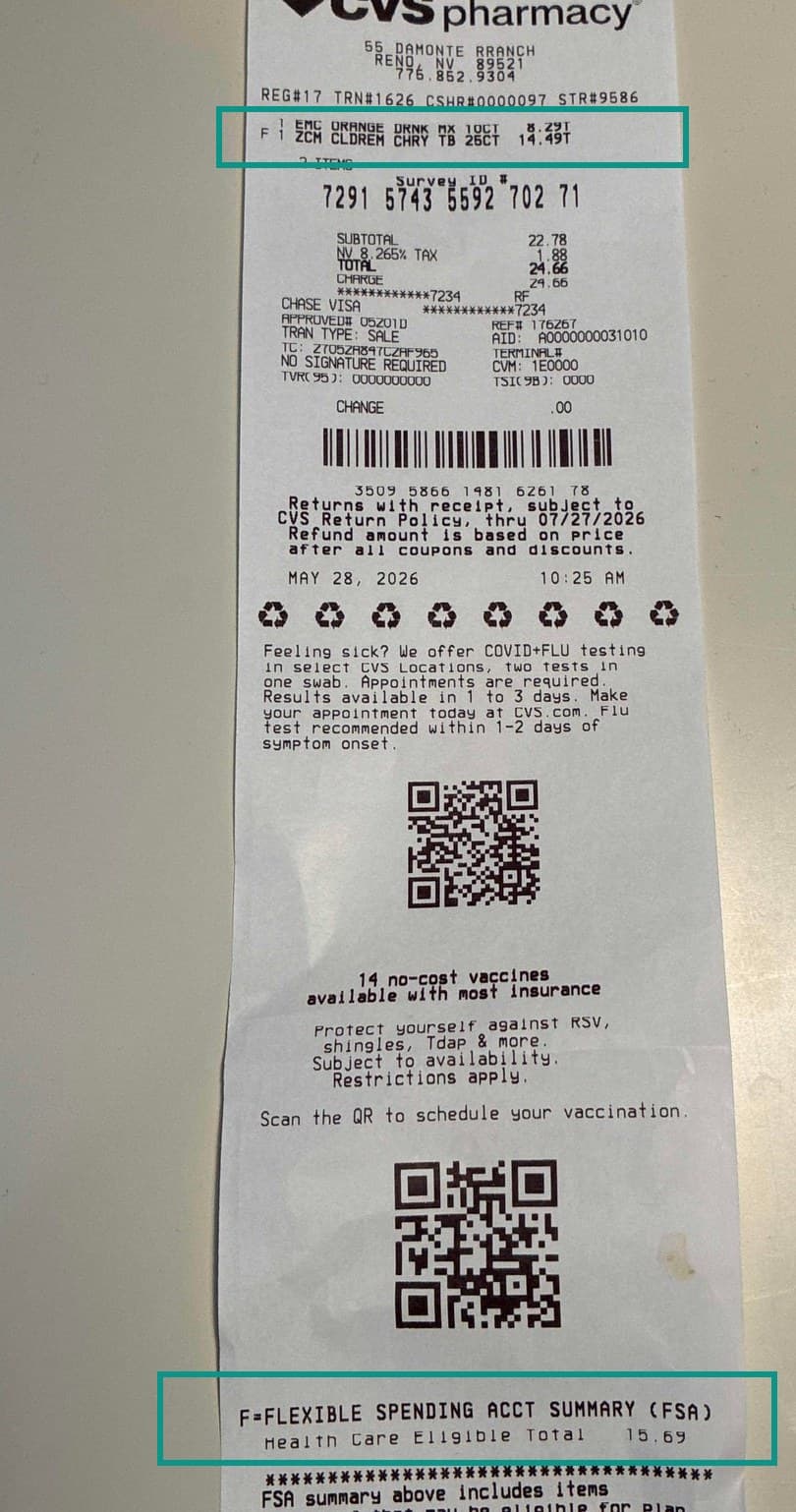
The flag and the summary total can disagree. An item can be F-flagged and still not count toward the summary total. CVS runs stricter eligibility logic when calculating that bottom-line number. When the two conflict, the summary line wins.
Save the full receipt. Do not just write down the total. The summary line is your proof, the line items are how you defend it in an audit.
Walking Through a Real CVS Receipt
The receipt in the image shows two items. Subtotal $22.78. With tax, $24.66. The FSA Health Care Eligible Total at the bottom prints $15.69.
Both items show an F prefix on this receipt. Yet only $15.69 of the $22.78 qualified. The F flag and the summary total disagreed. That is normal.
The lesson: the F flag tells you what CVS tagged as a candidate. The summary line tells you what CVS actually approved. For HSA records, use the summary line. $15.69 is the number you record. Not $22.78.
CVS ExtraCare Pharmacy Receipts
Pharmacy receipts are different from in-store retail receipts at CVS. Prescriptions print on a separate receipt with the prescription number, drug name, and amount paid. Every line on a pharmacy receipt is HSA-eligible by default.
Per IRS Publication 502, prescribed medicines and drugs are qualified medical expenses. No flagging needed. No summary line needed.
Keep pharmacy receipts the same way you keep retail receipts. They are simpler to read, but they still need to be saved for HSA records. Prescription receipts are also easier to defend in an audit because the prescription itself is the documentation.
Co-pays and insurance adjustments also appear on pharmacy receipts. Only the amount you actually paid out of pocket counts as an HSA-eligible expense. Insurance-covered portions do not. The pharmacy receipt prints both numbers, so the breakdown is clear.
Pick up a prescription and a retail item in one trip? You usually get two separate receipts. One pharmacy, one front-of-store. File them separately. Match each to its eligible total.
How to Pull a Past CVS Receipt
CVS keeps three records of a past purchase. Any one of them works for HSA proof. Lost the paper receipt? Pull the record back like this.
- ●ExtraCare digital receipts. If your purchase was tied to an ExtraCare account, the receipt is in the CVS app under Account, then Receipts. Front-of-store and pharmacy purchases both show here.
- ●Pharmacy records. Prescription history lives in your pharmacy account. Sign in on cvs.com or the app and open Prescriptions. You can print a full payment summary for the year, which many people use for HSA and tax records.
- ●In-store lookup. Ask the store to reprint a recent receipt. If you paid by card, they can search by the card and date. This works best within the last 30 to 60 days.
Save whatever you retrieve. A reprinted receipt still shows the F flags and the FSA Health Care Eligible Total, so it holds up the same way in an audit.
Common CVS Categories and Eligibility
Here is how the most common CVS purchases map to HSA eligibility.
| Category | HSA Eligible? | Notes |
|---|---|---|
| Prescription medications | Yes | Always. IRS Pub 502. |
| OTC pain relievers (Tylenol, Advil) | Yes | CARES Act 2020 removed the prescription requirement. |
| Cold and allergy meds (Dayquil, Zyrtec) | Yes | CARES Act 2020. |
| First-aid supplies (bandages, gauze) | Yes | IRS Pub 502 lists bandages. |
| Sunscreen SPF 15+ | Yes | Broad-spectrum SPF 15 or higher. |
| Menstrual care products | Yes | CARES Act 2020. |
| Vitamins and supplements | No | Unless a doctor provides a Letter of Medical Necessity. |
| Cosmetics, candy, beverages | No | General retail. Not medical. |
| Toothpaste, mouthwash (general) | No | General hygiene, not treatment. |
Prescription medications
- HSA Eligible?
- Yes
- Notes
- Always. IRS Pub 502.
OTC pain relievers (Tylenol, Advil)
- HSA Eligible?
- Yes
- Notes
- CARES Act 2020 removed the prescription requirement.
Cold and allergy meds (Dayquil, Zyrtec)
- HSA Eligible?
- Yes
- Notes
- CARES Act 2020.
First-aid supplies (bandages, gauze)
- HSA Eligible?
- Yes
- Notes
- IRS Pub 502 lists bandages.
Sunscreen SPF 15+
- HSA Eligible?
- Yes
- Notes
- Broad-spectrum SPF 15 or higher.
Menstrual care products
- HSA Eligible?
- Yes
- Notes
- CARES Act 2020.
Vitamins and supplements
- HSA Eligible?
- No
- Notes
- Unless a doctor provides a Letter of Medical Necessity.
Cosmetics, candy, beverages
- HSA Eligible?
- No
- Notes
- General retail. Not medical.
Toothpaste, mouthwash (general)
- HSA Eligible?
- No
- Notes
- General hygiene, not treatment.
The CARES Act changed the OTC rules permanently in January 2020. Before that, OTC meds needed a prescription to qualify. Now they do not.
Vitamins are the most common false-positive. People assume they qualify because they are sold at a pharmacy. IRS Publication 502 says no, unless a medical practitioner prescribes them for a specific diagnosed condition.
For a full breakdown of what qualifies and what does not, see the complete HSA-eligible expenses list. For background on the OTC rule change, see the CARES Act and OTC eligibility.
What to Do If the F Flag Is Missing
Sometimes the CVS point-of-sale misses an item that should qualify. Maybe a product was reclassified recently. Maybe a SKU was set up wrong. Maybe the item is borderline and CVS plays it safe.
You have options.
- ● Save the receipt and the product packaging.
- ● Look up the item in IRS Publication 502 or against the post-CARES Act OTC rules.
- ● Ask the CVS pharmacist or store manager for a corrected receipt.
- ● Claim the item manually with your HSA administrator. Include the receipt plus a reference to the IRS rule that supports eligibility.
CVS's F flag is helpful, not authoritative. The IRS is the authority. If you are confident an item qualifies under federal rules, you can claim it even without the F flag. You just need the documentation.
The reverse is also true. An F flag does not guarantee IRS eligibility forever. Rules change. Keep the receipt.
A Letter of Medical Necessity is the most common workaround for borderline items. If a doctor prescribes a normally non-eligible item to treat a specific condition, it can qualify. Vitamins, special diets, and certain supplements all fall into this category. The letter goes in the audit file alongside the receipt.
How Tripl Catches CVS Receipts For You
Tripl is an HSA receipt tracker that does the F-flag vs SUMMARY-line reconciliation for you.
- ● Upload the CVS receipt as a photo, PDF, or email forward.
- ● Tripl reads the line items, the F flags, and the FSA Health Care Eligible Total at the bottom.
- ● It auto-categorizes the expense. It uses the SUMMARY total as the authoritative eligible amount, not the F-flag sum.
- ● The receipt image stays attached to the record for audit defense. Eligible total and reimbursement date are already filled in.
That last part matters. HSA receipts need to survive as long as you might be audited. Storing them in a shoebox or a phone camera roll is fragile. Tripl ties the image to the eligible dollar amount and the reimbursement record automatically.
Tripl is $30 per year for the first 100 sign-ups, then $50 per year. No subscription tier games. No free trial that turns into a charge.
For the sibling guide on Walgreens receipts, see how Walgreens marks HSA-eligible items.
This is educational content, not financial or tax advice. Consult a qualified professional before making decisions about your HSA.