Your HSA Provider Matters More Than You Think
Most people open an HSA through whatever provider their employer picked. They never question it. They contribute, maybe use the debit card a few times a year, and move on.
Here is why that is a problem: the difference between the best and worst HSA providers can cost you tens of thousands of dollars over a career. Fees, investment options, cash interest rates, and minimum balance requirements all add up over time. A provider that charges $3.95 per month and pays 0.05% on your cash balance is structurally worse than one that charges nothing and pays 3.3%.
If you have the option to choose your own HSA provider (and yes, you can open one independently even if your employer does not offer it, as long as you have an HDHP), the choice is worth getting right.
We compared the six most popular HSA providers on the metrics that actually matter. Here is what we found.
The Quick Answer
If you are opening an HSA on your own and want the short version: Fidelity is the best HSA provider for most people in 2026. Zero fees, zero minimums, the highest cash interest rate, and full brokerage access with zero-expense-ratio index funds. No other provider matches it across all categories.
If you want to understand why, or if your situation is different, keep reading.
Best HSA Provider for Investment Growth in 2026
If your goal is investment growth, Fidelity is the answer. Three reasons. First, $0 minimum to start investing means every dollar you contribute can buy index funds on day one. No cash floor sitting at 0.01%. Second, the fund menu includes Fidelity ZERO funds with 0.00% expense ratios. Over 30 years that fee gap is real money. Third, no maintenance fees eat into the balance while it grows.
Lively comes second for investment growth, but only if you are willing to keep $3,000 in cash or pay $24/yr. HSA Bank ranks third with full Schwab brokerage. HealthEquity, Optum, and Further fall behind on either fund selection, cash rate, or fees.
For a year-by-year breakdown of how a $4,400 annual contribution grows at each provider, see the comparison below.
What We Compared
Every provider was evaluated on five criteria:
- ●Monthly and annual fees (maintenance fees, investment fees, account minimums)
- ●Investment options (fund selection, brokerage access, self-directed vs. limited menu)
- ●Cash interest rate (what your uninvested balance earns)
- ●Minimum balance to invest (how much cash you must keep before investing)
- ●Best use case (individual account vs. employer-sponsored)
The Full Comparison
1. Fidelity HSA
| Category | Details |
|---|---|
| Monthly fee | $0 |
| Investment options | Full brokerage: 10,000+ mutual funds, stocks, ETFs, all commission-free. Includes 4 Fidelity ZERO index funds with 0.00% expense ratios. |
| Cash interest rate | ~3.3% (Fidelity Government Cash Reserves money market) |
| Minimum to invest | $0. First-dollar investing, no threshold. |
| Debit card | Visa, works with Apple Pay and Google Pay |
Why it wins: Fidelity charges nothing. No monthly fee, no investment fee, no account minimum, no closing fee. Your uninvested cash earns money market rates (~3.3%) instead of the 0.01% to 0.05% that most providers pay. And the investment platform is the same one Fidelity offers for brokerage and retirement accounts: full access to stocks, ETFs, and thousands of mutual funds, including four index funds with literally zero expense ratios.
On a $10,000 uninvested balance, Fidelity pays roughly $330 per year in interest. Most other providers pay $1 to $5. That gap alone justifies switching.
Best for: Anyone opening their own HSA. Long-term investors. People who want the best deal without any asterisks.
2. Lively HSA
| Category | Details |
|---|---|
| Monthly fee | $0 |
| Investment options | Schwab self-directed brokerage (stocks, ETFs, mutual funds) or Devenir guided portfolio |
| Cash interest rate | 0.01% to 0.12% |
| Minimum to invest | $0 with $24/year fee, or free if you keep $3,000+ in cash |
| Debit card | Yes |
The catch: Lively used to be the go-to recommendation alongside Fidelity. Then they switched from TD Ameritrade to Schwab and added a $24 per year investment access fee (waived if you keep $3,000 or more in your cash balance). That $3,000 cash lockup means $3,000 earning 0.01% instead of being invested. At 7% returns, that costs you roughly $210 per year in opportunity cost.
Best for: Fee-conscious investors who specifically want Schwab brokerage access. A solid second choice, but Fidelity is objectively better on every metric.
3. HSA Bank
| Category | Details |
|---|---|
| Monthly fee | $0 (investment custodial fee: 0.30% per year, waived if $7,500+ cash balance) |
| Investment options | Schwab self-directed brokerage (funds, stocks, ETFs) or 31 pre-selected mutual funds |
| Cash interest rate | 0.01% to 0.15% |
| Minimum to invest | $1,000 must remain in cash at all times |
| Debit card | Yes |
The trade-off: HSA Bank has strong investment options through Schwab, and they eliminated monthly maintenance fees. But the 0.30% annual custodial fee on investments adds up. On a $50,000 invested balance, that is $150 per year. And the $1,000 cash lockup requirement means a chunk of your money always sits uninvested.
Best for: People whose employer uses HSA Bank. The Schwab brokerage access is competitive if you are already locked into this provider.
4. HealthEquity
| Category | Details |
|---|---|
| Monthly fee | $3.95/month (waived if cash balance is $2,500+) |
| Investment options | 23 Vanguard mutual funds. No self-directed brokerage option. |
| Cash interest rate | 0.05% to 0.36% |
| Minimum to invest | $500 |
| Debit card | Yes |
The limitation: HealthEquity is the largest non-bank HSA custodian (7.5 million accounts), but their individual offering is not competitive. The monthly fee, limited Vanguard-only fund menu, and lack of brokerage access make it hard to recommend for anyone choosing their own provider.
Best for: People whose employer uses HealthEquity. Not recommended for individual account openers.
5. Optum Bank
| Category | Details |
|---|---|
| Monthly fee | $3.75/month (waived if balance exceeds $5,000) |
| Investment options | 31 pre-selected mutual funds, Betterment robo-advisor, or Schwab self-directed brokerage |
| Cash interest rate | Not prominently disclosed (estimated below 0.5%) |
| Minimum to invest | $2,000 |
| Debit card | Yes |
The friction: Optum has decent investment options including Schwab brokerage access. But the $3.75 monthly fee, $5,000 waiver threshold, and $2,000 investment minimum create friction that zero-fee providers do not have.
Best for: People on a UnitedHealth Group plan whose employer uses Optum.
6. Further (formerly SelectAccount)
| Category | Details |
|---|---|
| Monthly fee | $1 to $4/month + $18/year investment fee |
| Investment options | 30+ pre-selected mutual funds. Schwab brokerage requires $10,000+ investment balance. |
| Cash interest rate | Not prominently disclosed |
| Minimum to invest | $1,000 cash minimum. Schwab brokerage requires $10,000 invested. |
| Debit card | Yes |
The barrier: Further's $10,000 minimum for Schwab brokerage access is the highest threshold of any provider we reviewed. Combined with monthly fees and the annual investment fee, this is the least competitive option for individual account holders.
Best for: People whose employer uses Further. Not recommended for anyone choosing their own provider.
Can You Switch HSA Providers?
Yes. You can transfer your HSA balance to a different provider at any time, regardless of who your employer uses. This is called a trustee-to-trustee transfer. It does not count as a contribution or distribution, and there are no tax consequences.
The process usually takes 1 to 3 weeks. You fill out a transfer form with your new provider, and they pull the funds from your old one. Some providers charge a small closing or transfer fee ($20 to $25 is common), but even a one-time $25 fee is worth it if you are moving from a provider that charges $3.95 per month to one that charges nothing.
Important: If your employer contributes to your HSA, those contributions typically must go to the employer's chosen provider. But you can periodically transfer the balance to your preferred provider. Some people set up quarterly or annual transfers.
What If Your Employer Does Not Offer an HSA?
You do not need your employer to open an HSA. The only requirement is that you are enrolled in a qualifying HDHP. If you buy your own HDHP through the marketplace or directly from an insurer, you can open an HSA at any provider and contribute up to the 2026 limits ($4,400 individual, $8,750 family).
The difference: employer payroll contributions bypass FICA taxes (saving you an extra 7.65%), while direct contributions only get you the income tax deduction. That FICA savings is worth $337 on a $4,400 contribution. If your employer offers payroll HSA deductions, use them for the FICA benefit, then transfer the balance to your preferred provider if needed.
The Bottom Line
For anyone opening their own HSA or choosing where to move an existing balance, Fidelity is the clear winner. Zero fees, zero minimums, the best cash rate, and the broadest investment options. No other provider matches it.
If you are stuck with an employer-chosen provider, check whether your provider charges monthly fees and what the investment options look like. If the fees are high or the fund selection is limited, consider periodic transfers to Fidelity (keeping just enough in the employer account to receive their contributions).
The HSA is the most tax-advantaged account in the entire tax code. Picking the right provider ensures you capture every dollar of that advantage instead of bleeding it away in fees and lost interest.
After You Pick a Provider
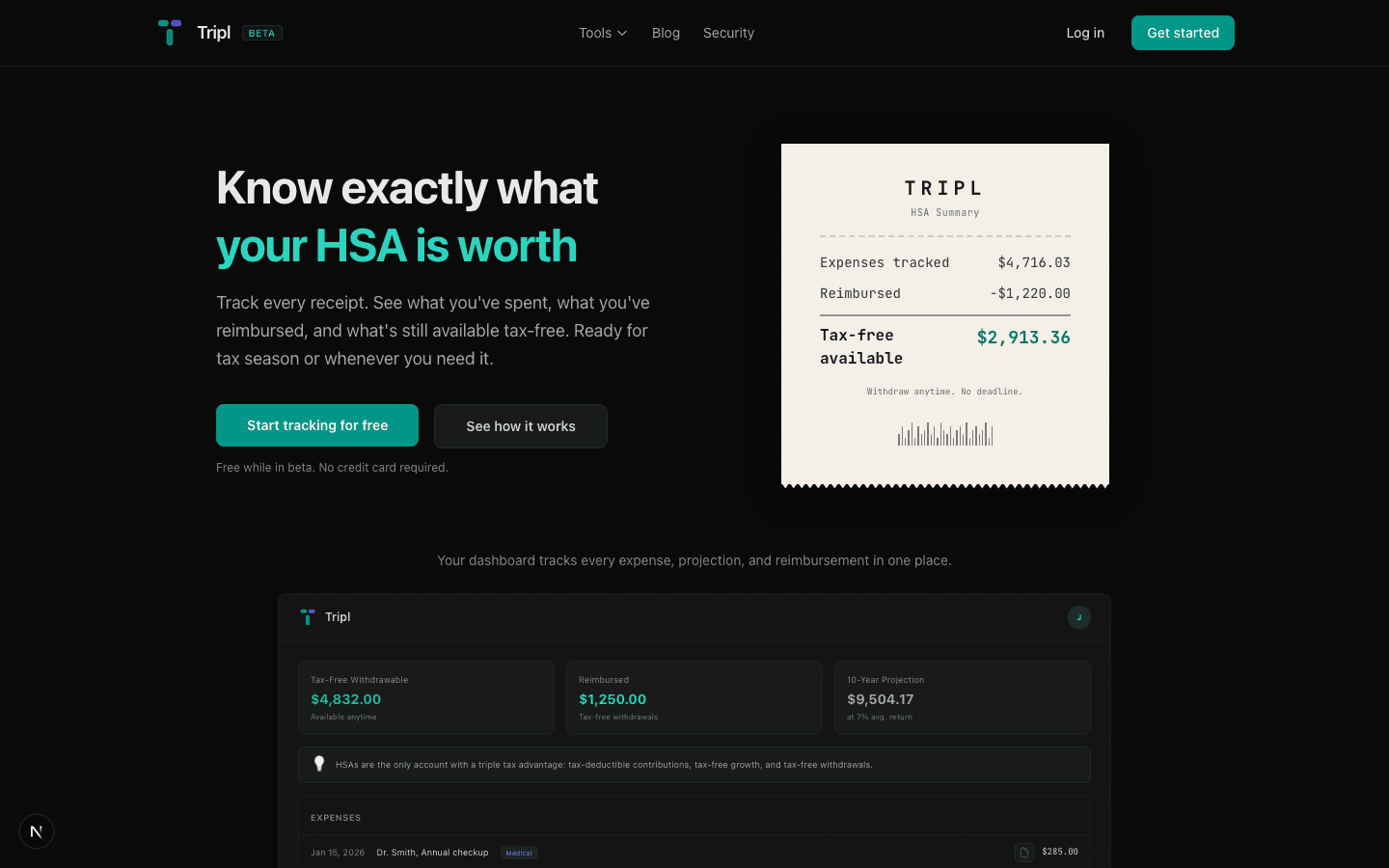
Your provider holds the money and handles investments. Some offer basic receipt storage. None of them parse your receipts automatically, track your reimbursements, or generate a tax-year report for your records. That is what Tripl adds on top of whichever provider you choose. It also shows growth projections on unreimbursed expenses so you can decide when to claim them.
*This is educational content, not financial or tax advice. Consult a qualified professional before making decisions about your HSA.*